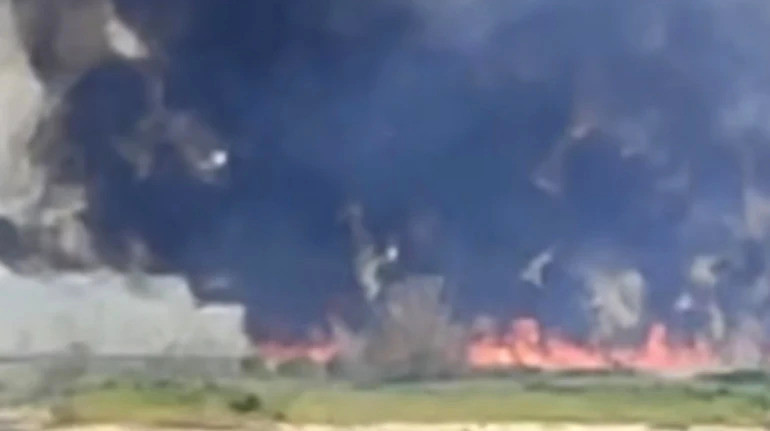


At the bottom of the Kakhovka Reservoir, which dried up after the explosion of the hydroelectric station by Russian forces in 2023, fires are a common occurrence. The flames destroy potential foundations for the recovery of the local ecosystem.
Videos of another large fire have been published by the State Ecological Inspection of the Southern District.
Experts state that the terrorist act at Kakhovka Hydroelectric Station led to a loss of water in the reservoir and disrupted the natural balance. Consequently, fires regularly ignite in the dried areas.
The State Ecological Inspection reports that the fires occur suddenly but spread rapidly, leaving scorched earth in their wake.
"Reeds, dry vegetation, and bushes are burning—those remnants that could still serve as a basis for ecosystem recovery. Wildlife is dying, and habitats for birds and reptiles are being destroyed. Smoke pollutes the air, and rescuers are working under challenging conditions," the service noted.
Experts urged locals to avoid creating conditions that could lead to fires and to immediately call firefighters at 101 if any fire is detected.
"Do not complicate an already difficult situation [...] If you see a fire or its consequences, document and report it. Every signal is important," emphasized the State Ecological Inspection.
Recall that Russian forces blew up the Kakhovka Hydroelectric Station in June 2023. As a result of the terrorist act, the station was completely destroyed, causing the water level in the reservoir to drop sharply and uncontrollably.
In the Ukrainian-controlled territory of Kherson region, 31 people died due to the destruction. According to media reports, the Russian occupation administration deliberately concealed the number of flood victims from the terrorist act—at least a hundred people died in Oleshky alone.
As of early 2025, estimates showed that the damage from the explosion of the hydropower station reached approximately 14 billion dollars.
"Ukrhydroenergo" announced that they are ready to begin the reconstruction of the Kakhovka Hydroelectric Station dam at any moment after the end of the war. They have created a 3D model and planned preparatory work, communications, and the construction of a temporary dam.