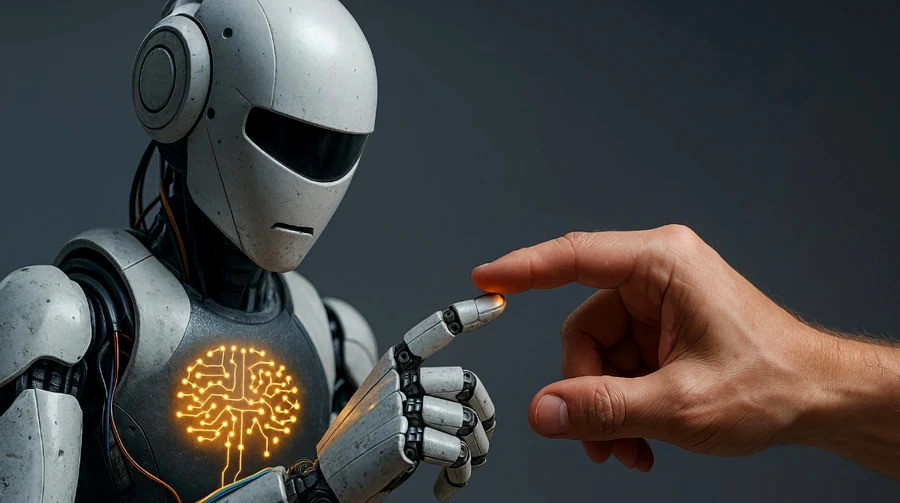


A team of researchers from the Korea Advanced Institute of Science and Technology (KAIST) has developed an innovative artificial sensory nervous system for robots that can differentiate between safe and dangerous touches, mimicking the behavior of living organisms. This was reported by Interesting Engineering.
This technology is based on a neuromorphic semiconductor – a new type of memristor that can respond to external stimuli without the need for complex software or high computational power.
In animals and humans, familiar stimuli such as air conditioning noise or clothing on the body are gradually ignored, while new or dangerous signals, like sudden touches or pain, elicit immediate reactions. This mechanism is regulated through two processes: habituation (diminishing the reaction to repeated safe stimuli) and sensitization (increasing the reaction to threatening stimuli). The KAIST team was able to replicate these mechanisms electronically.
The innovation lies in the unique design of the new memristor. Unlike previous models that could only change conductivity in one direction, this device features an additional internal layer that allows for conductivity changes in the opposite direction. This enables the memristor to reduce sensitivity to repetitive touches while quickly activating in response to painful signals.
To test the development, researchers integrated the system into an artificial hand. Initially, it reacted to every touch. Over time, if touches were repeated without threat, the reaction decreased. However, when the same touches were combined with an electric current, the hand became highly sensitive again.
This breakthrough demonstrates that artificial nervous systems can be compact, energy-efficient, and operate without complex software, paving the way for a new era in robotics.