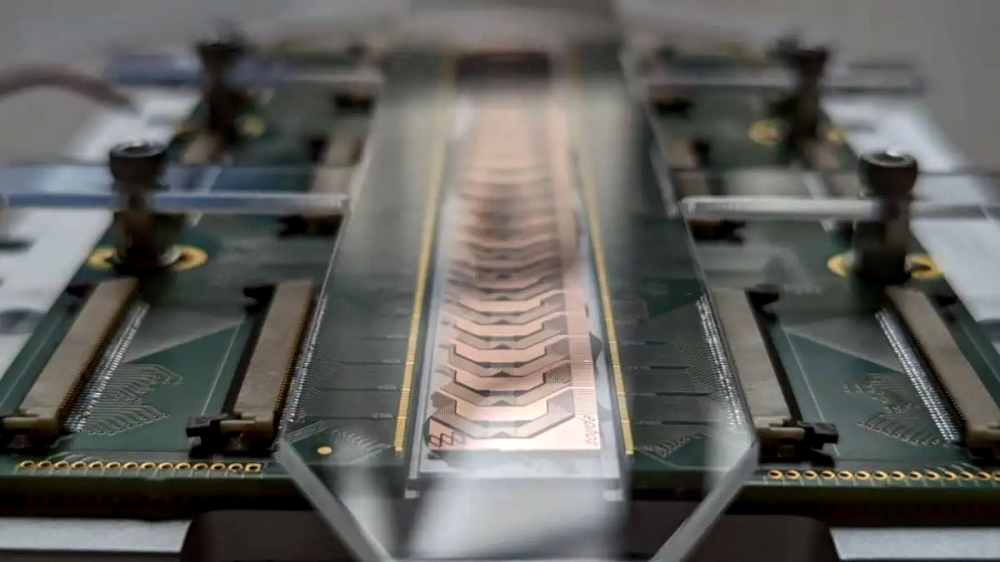


A collaborative effort by scientists from Italy, Germany, and France is underway to develop a new quantum computer utilizing glass photonic chips.
While quantum computers are expected to greatly surpass traditional ones, there are numerous challenges in realizing practical and efficient devices. This initiative from the Polytechnic University of Milan brings together experts from leading research institutions and small to medium enterprises in France, Italy, and Germany to enhance quantum properties using glass.
Researchers are employing photonic chips designed by Ephos in the creation of photonic quantum computers. These chips process and transmit information using light, supporting up to 200 reconfigurable optical modes, allowing dynamic control of light movement within the chip.
"It is essential to use materials that transmit light. This is a complex task since we need to confine the light while avoiding its absorption. If light is absorbed, it cannot propagate further," explains Julia Acconcia from the Polytechnic University of Milan.
The scientists aim to generate single photons and direct them through glass circuits, which could eventually address pressing issues such as developing more efficient batteries, new medications, and unlocking the mysteries of the universe. Laser printing technology on glass shows great promise. During the work process, light particles are generated, which travel through optical fibers to the chip. Since everything is made of glass, the risk of photon deviation along the path is minimal.
Currently, the German company Pixel Photonics is enhancing ultra-sensitive detectors for detecting each photon. Meanwhile, Schott AG manufactures and supplies high-quality glass substrates.
The research team led by Julia Acconcia is developing high-performance electronics to control the system. Simultaneously, experimental quantum optics experts from the University of La Sapienza are focused on generating single photons.
The Unified Fund of France is developing open-source software for quantum computing. Teams from the National Center for Scientific Research and the University of Montpellier are modeling advanced solutions for energy storage, which is a vital foundation for future quantum technology programs.
The QLASS researchers share a common goal: to create a functional photonic quantum device at the University of La Sapienza by 2026. After the project's completion, the software developed at the University of Montpellier and the Unified Fund will enable testing of this device.
The first task of the new quantum computer will be to develop more advanced lithium-ion batteries. By using variational quantum algorithms—special instructions that help quantum machines solve problems more efficiently—quantum computing can model battery chemistry, accelerate the search for new materials, and even enhance state monitoring.
While scientists understand the laws governing atoms and compounds, tracking their interactions in real-time is incredibly complex and beyond the capabilities of current silicon computers. Researchers expect that quantum computers will help expedite the development of new materials for batteries and pharmaceuticals.
The findings of the study are published in Horizon Magazine.
Source: ZMEScience