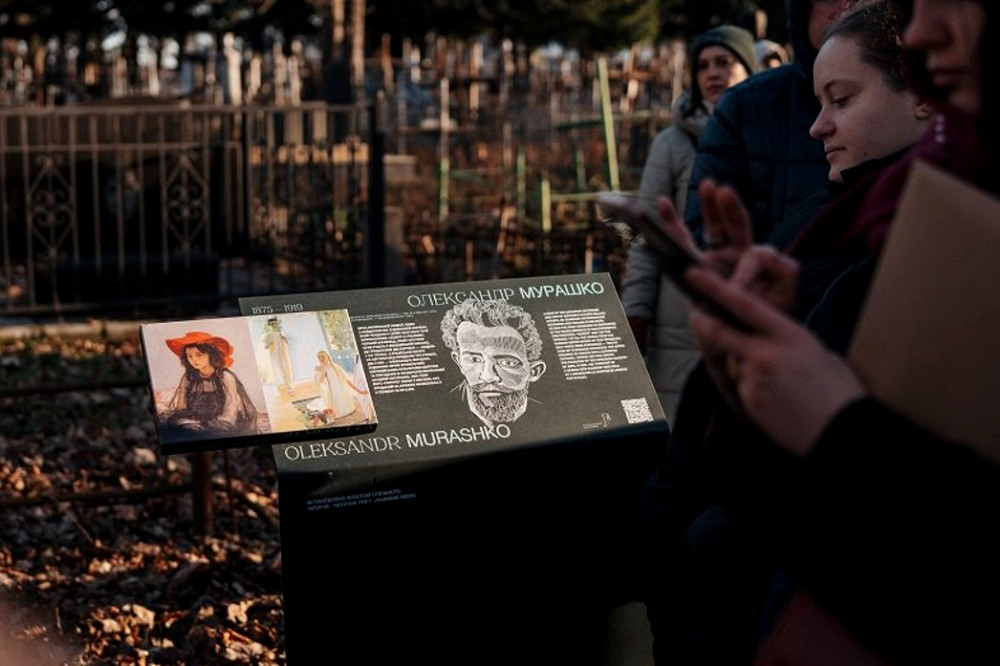


In Kyiv, at the Lukyanivka memorial site, a new memory route has been introduced, featuring the graves of eight prominent Ukrainian artists from the 19th and 20th centuries.
The route is equipped with informational stands, and audio guides are available in Ukrainian and English via QR codes. The Ukrainian version is narrated by actress Rimma Zubina.
The memory route includes the following artists:
- Volodymyr Orlovskyi (1842–1914) — a pioneer of the Ukrainian landscape school.
- Mykola Murashko (1844–1909) — founder of the Kyiv Drawing School and author of the first Ukrainian drawing textbooks.
- Serhiy Svyatoslavskyi (1857–1931) — a master of plein air painting known for his attention to light.
- Mykola Pymonenko (1862–1912) — a realist painter and a distinguished master of genre painting.
- Oleksandr Murashko (1875–1919) — a key figure in Ukrainian Art Nouveau.
- Fedir Krychevskyi (1879–1947) — artist and educator, the first rector of the Ukrainian Academy of Arts.
- Oleksandr Bohomazov (1880–1930) — an avant-gardist and one of the first theorists of avant-garde art.
- Victor Palmov (1888–1929) — an avant-gardist who developed the concept of color painting.
Information about the route, audio guides, and details about the artists can also be found on the “Invisible Gallery” page of the media outlet The Ukrainians, which created this project with the support of Lady Di Atelier. Partners of the project include the Lukyanivka memorial and the National Art Museum of Ukraine. The idea was developed by journalist Darika Hirna.
The heroes of our route have either been appropriated by the Russian Empire for decades or erased from our national memory through Soviet repressions. We want to emphasize that these artists, who shaped the history of Ukrainian and world art, are buried on Ukrainian soil. Many prominent Ukrainians are still scattered across the globe due to the two major wars that swept through Ukraine in the 20th century. We also aim to draw attention to the condition of such graves and the importance of restoring them, in addition to pondering whether Ukraine is ready to return to the European context of memory culture, where a historical cemetery is not just a place of mourning but also a cultural space,” says Darika Hirna.